-1.svg?2026-03-24T14%3A21%3A04.000Z)
ELECTRICITY MINUS CARBON DIOXIDE = e-CO₂
Power a more sustainable future for your business with e-CO₂– an innovative solution that brings renewable electricity at fixed escalations directly to your office door.
POWERING YOUR SPACE TO THRIVE, SUSTAINABLY
Over the past decade, we’ve spearheaded the evolution of green building from a novel idea to a cornerstone of our approach. We prioritise strong Environmental, Social and Governance (ESG) strategies and results, and we understand why it’s crucial for our clients to do the same. That’s why we’ve embarked on an exciting journey towards renewable energy through our recent Power Purchase Agreement with Etana Energy, securing an impressive 195 GWh of clean electricity annually. And, while wheeling does not directly mitigate the impact of load-shedding on your premises, e-CO₂ makes it easy for your business to achieve its ESG goals.
WHEELING FACTSHEET→
Here's How It Works:
Wheeling is a process where electricity is bought and sold between private parties, using the existing grid to transport power from where it is generated to end-users that can be long distances apart. It creates greater access to affordable renewable energy and contributes to resolving the country’s energy crisis.

Generation
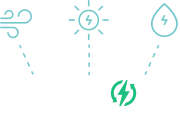
We tap into our natural resources—wind, water, and sunlight—to generate clean electricity.

Transmission
This green electricity flows seamlessly through the existing power grid.

Distribution
Although you won’t get the exact green electrons produced, you can still claim that at least 70% of your electricity is from green sources.
Generation
We tap into our natural resources—wind, water, and sunlight—to generate clean electricity.
Transmission
This green electricity flows seamlessly through the existing power grid.
Distribution
Although you won’t get the exact green electrons produced, you can still claim that at least 70% of your electricity is from green sources.
Clean Energy At Work

STAY LONGER, SAVE MORE
We offer fixed escalation on the variable component of the electricity price, ensuring long-term cost savings. The longer your lease, the more stable and potentially lower your electricity costs will be.
ALIGN POWER WITH PURPOSE
By opting for e-CO₂, you contribute significantly to your ESG goals – reflecting your commitment to sustainability and responsible business practices.
CERTIFIED EMISSION REDUCTION CERTIFICATE
Access to certified emission reduction certificate annually. This certificate can be used in your ESG reporting and showcase your dedication to green electricity.

•Minimum70%Clean Electricity
Opt-in and guarantee at least 70% of your power from renewable sources for maximum saving potential.
•Maximum100% Clean Electricity
Want to take your sustainability goals even further? Depending on the availability of additional capacity, you can power your business with 100% clean electricity. However, a renewable availability charge would apply.
*e-CO₂ is currently available only in specific jurisdictions and to select buildings within our portfolio. For a full list of buildings, please read our full T&Cs.

Track, trade and report your clean energy use
Tenants subscribed to e-CO₂ receive Renewable Energy Certificates (RECs) automatically, at no additional cost, for the renewable portion of their energy use. RECs are digital records that confirm one megawatt-hour of renewable energy has been generated and added to the grid. Without a REC, a business cannot claim the environmental benefit of clean energy use. e-CO₂ tenants are registered on a blockchain-based portal developed in partnership with Fuel Switch. This platform provides full visibility, control and management of green attributes, where tenants can track their RECs and view details such as energy source, issuance date, and location. The platform also allows tenants to redeem RECs to reduce Scope 2 emissions for use in ESG reporting or trade them on the voluntary market. This turns clean energy into a usable asset with environmental and commercial value.
Clean energy delivered through e-CO₂


Blockchain-certified RECs issued via Fuel Switch
Certified proof for reporting and trading
FAQs
While wheeling electricity alone won’t immediately eliminate load shedding, increasing renewable energy production will gradually stabilise the national grid, reducing load shedding in the future. You won’t notice any changes in how your power is delivered, as it will still come through the same Eskom network.
This approach can significantly cut down your business’s scope 2 emissions, and is often the most effective step towards achieving carbon neutrality. Scope 1: Direct emissions from sources owned or controlled by the company i.e. company vehicles burning fuel. Scope 2: Indirect emissions from the electricity the company consumes. These emissions can be significantly reduced by wheeling renewable energy. Scope 3: All other indirect emissions related to the company’s operations, including those from suppliers, customers, and employee commutes. By wheeling renewable energy, your business can make a substantial impact on reducing its environmental footprint.
Through our PPA with Etana Energy, Growthpoint has exclusive rights to purchase all of the roughly 30GWh that will be generated annually by a 5MW hydroelectric power plant situated in the Lesotho Highlands Water Scheme, expected to be operational from 1 September 2025. Following this, the wind and solar production from Etana’s portfolio will be added to the grid.
We will install a smart meter at your premises to track your consumption correctly!
Clean energy certification FAQs
A Renewable Energy Certificate, or REC, certifies that one megawatt-hour of renewable electricity was generated and added to the national grid. Each REC includes metadata that links it to the time, location and type of generation. It serves as formal proof of renewable energy generation.
Certifiable renewable energy is clean electricity that has been independently verified and recorded through a recognised system. In this case, Fuel Switch issues RECs that track every unit of renewable energy delivered through Growthpoint’s e-CO₂ initiative. This allows tenants to claim the environmental benefit of their clean energy use with confidence.
Tenants who have subscribed to the e-CO₂ initiative, receive RECs automatically for their portion of clean energy consumed. These certificates can be used to reduce Scope 2 emissions, improve ESG reporting or be traded in the voluntary carbon market. They offer both environmental and financial value.
Using renewable energy refers to physically consuming electricity that was generated from a renewable source. A REC is the verified proof that this renewable energy was produced.
No. Each REC is uniquely issued, assigned and retired after use. Only one entity can claim the environmental benefit. Growthpoint allocates RECs to its tenants that have subscribed to the e-CO₂ initiative, allowing them to claim their clean energy use directly.
RECs are tracked by REC Registries, of which South Africa’s national registry, zaRECs, as well as I-RECs, are recognised entities. Each certificate is recorded, time-stamped, assigned to a specific energy source and retired once used. Fuel Switch integrates directly with the relevant registries to ensure accuracy, transparency and compliance.
Bundled RECs are sold together with the physical electricity. Unbundled RECs are sold separately from the electricity they represent. Growthpoint tenants receive unbundled RECs through the e-CO₂ initiative, which allows energy to be delivered through the grid and certified independently.
Blockchain creates a secure digital record that tracks each REC from issuance to retirement. The record is tamper-proof, transparent and permanently accessible. This adds credibility and trust to the certification process, which is critical for ESG and audit purposes. Fuel Switch uses a carbon-neutral blockchain and smart contracts to ensure speed, reliability and security.
RECs represent the environmental attribute of renewable electricity that has been produced. Carbon Credits enable the holder thereof to reduce or remove greenhouse gas emissions from business activities. Both have value but serve different purposes. RECs are used to offset Scope 2 emissions, while Carbon Credits generally apply to offsets of Scope 1 or Scope 3 emissions.
Scope 2 emissions are the indirect emissions produced by the generation of purchased electricity. For example, the emissions created by Eskom to power a building. Growthpoint tenants can reduce their Scope 2 emissions by redeeming RECs that certify that clean was generated which can be offset against their energy consumption.
Scope 1 emissions are direct emissions from company-owned sources such as vehicles or diesel-generators. Scope 3 emissions are all other indirect emissions in a company’s value chain, including those from suppliers, travel, commuting and waste. While RECs apply specifically to Scope 2, they can support broader sustainability reporting across all three scopes.
The first RECs will be available to tenants that have subscribed to the e-CO₂ initiative, with first energy to be produced for the e-CO₂ initiative from October 2025 when the Lesotho Highlands hydroelectric plant becomes operational. Wind and solar generation from Etana’s portfolio will be added to the e-CO₂ initiative from 2026 to 2028.
Growthpoint tenants subscribed to e-CO₂ are registered on a secure, blockchain-based platform. Through this portal, they can view their accumulated RECs, redeem them for ESG use, or trade them in the voluntary carbon market.
Yes. Growthpoint’s RECs are aligned with both local (zaRECs) and international (I-REC) certification standards. They meet accepted Scope 2 accounting frameworks and are valid for ESG disclosures globally – but can only be used to offset energy consumption within South Africa.
When a tenant leaves a building, they retain all RECs accumulated up to that point. However, to receive additional RECs going forward, they must remain subscribed to e-CO₂ in an eligible building.
Yes. This is the first commercial-scale model in South Africa’s property sector that enables tenants to receive certified clean energy via RECs. It creates a verifiable pathway for tenants to prove renewable energy use at building level.
Certification of clean energy generated enables Growthpoint to pass the benefit of clean energy to its tenants. This partnership makes it possible to measure and prove clean energy use at scale, with a system backed by recognised standards, blockchain technology and one of South Africa’s leading property owners which in turn creates accountability and transparency.
No. The use of RECs falls within the voluntary market. However, they are increasingly expected as part of ESG reporting, green finance, investor disclosures and supply chain compliance.
Fuel Switch is a blockchain-based platform that issues, tracks and verifies Renewable Energy Certificates (RECs) and Carbon Credits (CCs). It manages the full lifecycle of each certificate and ensures compliance with both global and local standards, including South Africa’s national registry, zaRECs, as well as the internationally recognised registry, I-RECs. Tenants access their certificates directly via the Fuel Switch platform.
Fuel Switch combines advanced blockchain infrastructure, smart contract automation and direct integration with multiple registries. It is built for scale, capable of handling over 10,000 transactions per second, and is already trusted by major corporates in South Africa. The platform is fully aligned with local and international registries, and offers a secure, transparent system for renewable energy certification.
Growthpoint has installed more than 61 Megawatt-peak of solar PV across its portfolio and has signed a power purchase agreement to wheel 195 Gigawatt-hours of renewable energy annually. To date, 122 of its properties hold green building certifications. Growthpoint aims to reach carbon neutrality by 2050 for buildings across its portfolio.